Wired Across the Wound
Updated: Mar 30
Ramanjit Singh
How India Kept Lahore's Lights On After Partition
In the fever of 1947, in the meeting rooms of Delhi, and London where Pakistan was argued into existence, the men who drew the new world spoke of sovereignty, of religion, of homeland. What they did not speak of, what perhaps they could not bring themselves to fully reckon with, were the wires. The roads. The railways. The canals that crossed every border they proposed. The Muslim League, Jinnah, and the architects of partition were consumed by the righteous urgency of separation; they had spent decades arguing that Hindus-Sikhs and Muslims were two nations who could not share a future. But they had already spent centuries sharing everything else.
The Shanan Power House and its transmission line to Lahore was not an anomaly, it was a symbol of how completely the subcontinent had been woven together under a single administration, a single grid, a single economic logic. You could declare two nations in an afternoon. You could not undeclare a hydroelectric plant. You could not redraw a canal headwork. You could not unpave a road or unlay a rail line with a stroke of Cyril Radcliffe's pen. And so, within days of independence, both countries found themselves doing the very thing partition was supposed to make unnecessary, negotiating with each other, depending on each other, paying each other, because the land itself refused to honor the ideology.
The electricity that lit Lahore's homes from a plant now standing in India was, in its quiet way, a daily verdict on the whole enterprise; that the ties binding Punjab together had been grown over generations and could not be wished away by a resolution, however passionately passed. The realization did not come loudly. It came in the form of bills sent across a border, of pylons standing in fields that now belonged to two different countries, of engineers on opposite sides of the Radcliffe Line who had trained together and now maintained the same grid in opposing uniforms. Partition had happened. But Punjab had not quite agreed to it yet.
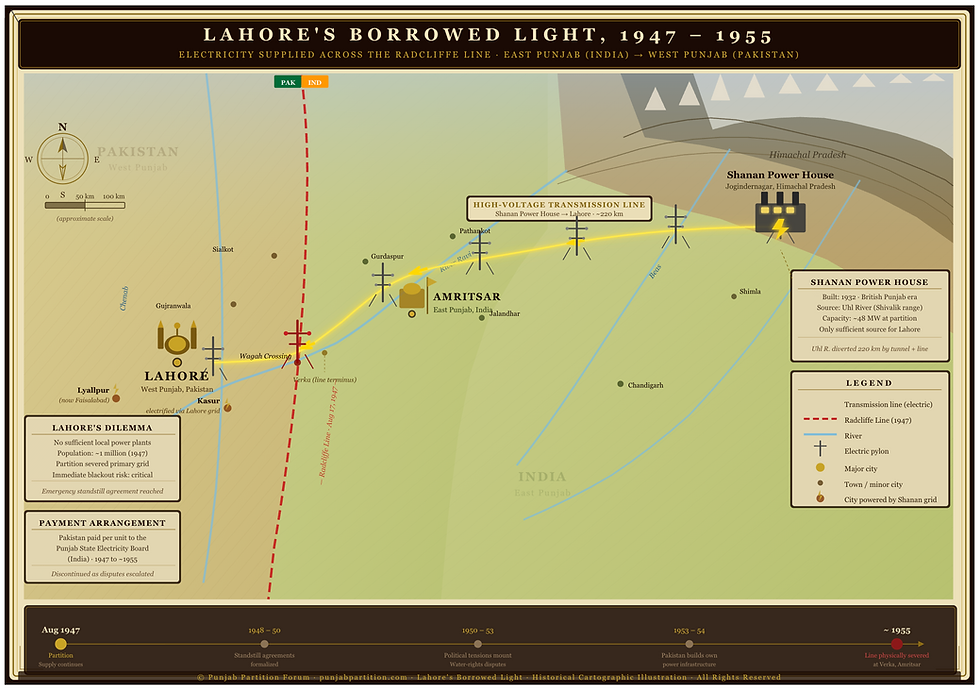
Long before the Radcliffe Line existed on any map, a single hydroelectric plant tucked into the Shivalik foothills of East Punjab (now Himachal Pradesh) had become the beating electrical heart of undivided Punjab. The Shanan Power House, commissioned in 1932 and built on the Uhl River near Jogindernagar in Mandi district, was conceived under British colonial administration by engineer Colonel B.C. Batty, and initially generated 48 megawatts, a remarkable output for its era.
Getting it built at all was an engineering feat that bordered on the improbable: an aerial ropeway and a haulage trolley system spanning the steep ravines were constructed just to move heavy equipment into position, in terrain where no conventional rail could go. The project was leased for 99 years in 1925 from the princely state of Mandi to the Punjab government, and from the moment it was switched on, it played a key role in supplying power to undivided Punjab, Lahore, and Delhi before Independence.
The line ran from Jogindernagar westward across the plains, through the transmission hub at Amritsar, and on to Lahore, Lyallpur (now Faisalabad), and Kasur; cities that had no sufficient local generation of their own. For Lahore especially, Shanan was not a convenience. It was the only game in town.
A Line That August 1947 Could Not Immediately Break
When Cyril Radcliffe published his boundary award on August 17, 1947, the Shanan Power House woke up on the Indian side of a new international border. Lahore woke up on the Pakistani side, with no meaningful alternative source of electricity. The transmission infrastructure, however, did not simply stop working. The Radcliffe Line bisected Punjab's elaborate shared infrastructure, and the post-partition framework attempted to manage the immediate fallout through standstill agreements, provisional pacts designed to preserve existing administrative arrangements until new ones could be negotiated. Cutting the power to Lahore overnight would have meant a complete blackout of Pakistan's second-largest city during the most violent population transfer in recorded history. Neither government had the political appetite for that. The wires stayed live.
Historical accounts and administrative summaries of the project confirm that supply continued under a bilateral arrangement, though the precise end year remains difficult to pin down from publicly digitized sources, with credible references ranging from the mid-1950s to as late as 1958, with the latter year appearing in several research summaries that link the disconnection to the broader decoupling of shared infrastructure ahead of the 1960 Indus Waters Treaty.
Pakistan Paid. India Supplied. The Pylons Did Not Care About Borders.
The cross-border supply was a commercial transaction. Pakistan paid the Indian Punjab State Electricity Board for every unit consumed, a billing arrangement that ran alongside the broader inter-dominion financial settlements being negotiated in Delhi and Karachi. The arrangement was not unique: following the lapse of the 1947 Standstill Agreement, India halted canal waters to Pakistan in April 1948, and a temporary Inter-Dominion Accord signed on May 4 restored the flow in exchange for annual payments, with the understanding that further negotiations would lead to a lasting resolution.
Electricity operated under the same logic. What gave Pakistan the leverage to negotiate continued supply was geography and desperation in roughly equal measure: the 48 MW Shanan plant was simply too large a dependency to abandon overnight. At the same time, Pakistan moved quickly to reduce that dependency. The Rasul Hydel Power Station was commissioned in 1952 with an installed capacity of 22 megawatts, the biggest hydel power project Pakistan commissioned after independence, located on the Jhelum Canal in what is now Mandi Bahauddin district. At only 22 MW, Rasul could not replace Shanan's 48 MW on its own, but it marked the beginning of Pakistan's ability to build toward grid independence. By the mid-to-late 1950s, as Pakistan's domestic generation capacity grew and diplomatic relations with India became increasingly strained, particularly over the Indus waters, the commercial and political logic of the cross-border supply collapsed. After 1958, the supply to Lahore was halted and the transmission line was terminated at Verka village in Amritsar.
The Steel Poles at Verka: Evidence in the Landscape
The clearest physical proof that the cross-border supply once existed sits quietly in a village on the outskirts of Amritsar. At Verka, the transmission line simply ends, the British-era steel towers stop at what became the Indian side of the border, pointing west toward a grid they can no longer reach. The iron towers erected along the route have withstood decades of harsh weather, heavy rain, snow, heat, and wind, and yet show little corrosion even today. Experts say the durability reflects the superior quality of material and craftsmanship used during the British period; unlike many modern structures that require frequent maintenance, these nearly century-old towers continue to function with minimum repairs. That the line was not dismantled, that it was simply severed at the border and left standing, speaks to the abruptness of the final severance and to how recently, in historical terms, these two cities shared an electrical grid. The poles in the Majha region of Indian Punjab that once carried current into Pakistan are now an industrial heritage artifact, increasingly recognized as such by historians on both sides.
Sources:
The Tribune India — Engineering marvel: British-era Shanan powerhouse transmission towers still stand firm — https://www.tribuneindia.com/news/himachal/engineering-marvel-british-era-shanan-powerhouse-transmission-towers-still-stand-firm/
The Tribune India — Shanan power house: From engineering marvel to crumbling relic — https://www.tribuneindia.com/news/himachal/shanan-power-house-from-engineering-marvel-to-crumbling-relic/
Drishti IAS — Dispute over the Shanan Hydropower Project — https://www.drishtiias.com/daily-updates/daily-news-analysis/dispute-over-the-shanan-hydropower-project
Daily Pioneer — Shanan Hydropower Project Row Escalates — https://www.dailypioneer.com/2025/state-editions/shanan-hydropower-project-row-escalates--punjab--himachal-clash-over-ownership-as-lease-ends-after-99-years.html
Britannica — Radcliffe Line — https://www.britannica.com/place/Radcliffe-Line
Dawn — Seven-decade old power station to be rehabilitated (Rasul Hydel, 1952) — https://www.dawn.com/news/1609029
Business Recorder — Wapda to rehabilitate Rasul Hydel Power Station — https://www.brecorder.com/news/40067356/wapda-to-rehabilitate-rasul-hydel-power-station
Lukmaan IAS — Punjab-Himachal Dispute over Shanan Hydropower Project — https://blog.lukmaanias.com/2024/03/06/punjab-himachal-dispute-over-shanan-hydropower-project/
Wikipedia — Shanan Power House — https://en.wikipedia.org/wiki/Shanan_Power_House


Comments